The 3 Systems Every Trades Business Needs to Scale
Introduction
You already know this feeling.
The jobs are coming in. Your reputation is solid. Word travels fast in this industry, and right now, it’s travelling in your favour. But somehow — and this is the part that doesn’t make sense when you’re in it — the busier things get, the more trapped you feel.
More work means more calls to return.
More calls to return means more evenings on the phone.
More evenings on the phone means less of everything else.
The instinct is to push harder. Hire someone. Spend more on ads. Get up earlier.
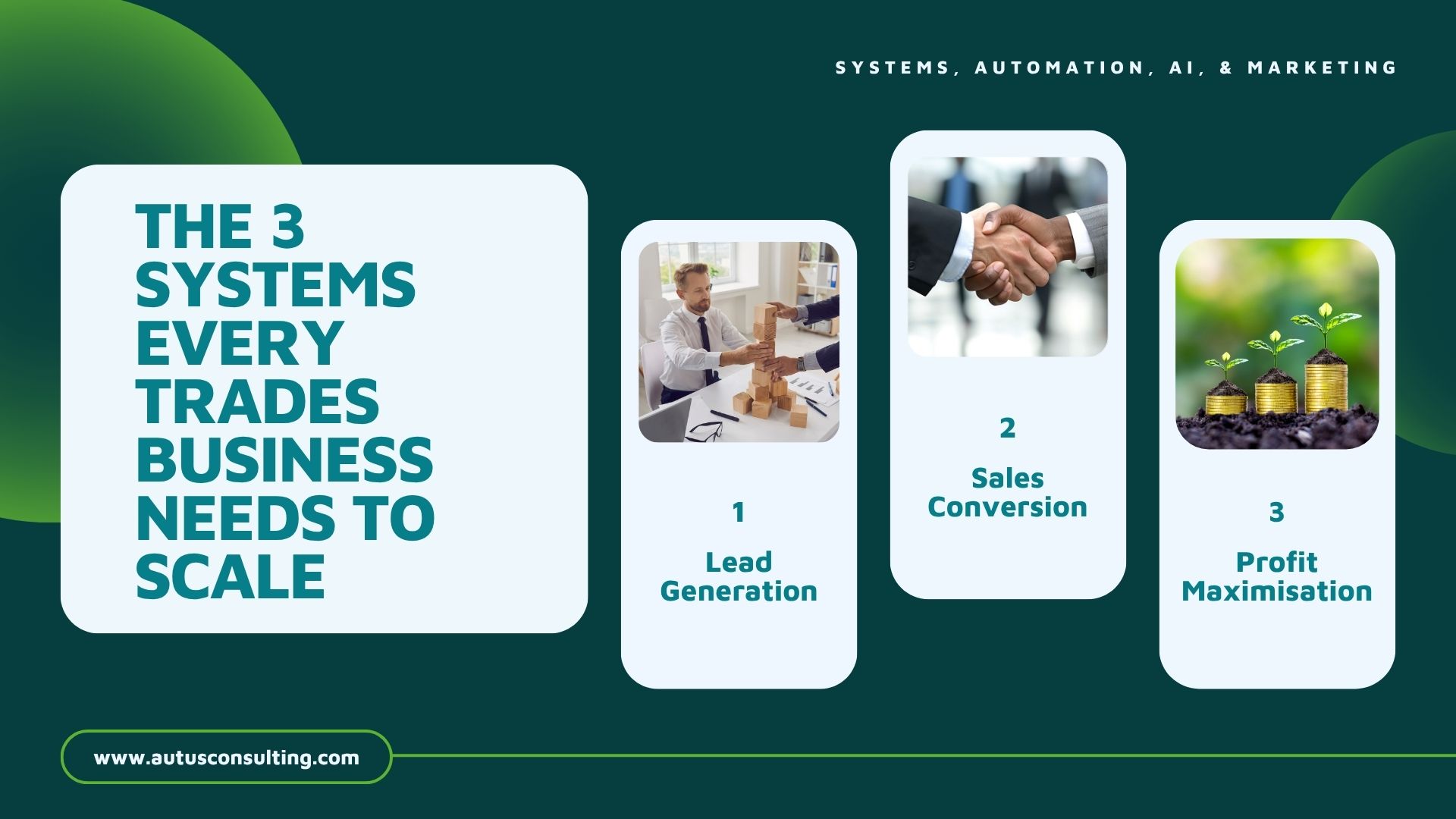
But here’s what the trades businesses that actually break through have figured out: the ceiling isn’t a work ethic problem. It’s a systems problem. And there are three specific systems that remove it — built in a specific order.
Why the Ceiling Exists in the First Place
You’re good at what you do. Word gets around. Work starts coming in. And because you’re the best person to win the job and the best person to do the job, everything runs through you.
That’s fine when you’re doing a couple of jobs a week. It starts to crack when you’re doing four or five. And it breaks completely when you’re trying to manage a team, quote new work, handle complaints, return calls, and be on site — all at the same time.
The business has grown around one person’s capacity. And one person’s capacity has a ceiling.
The three systems don’t replace you. They just stop the business from requiring you to be everywhere, all the time, for everything.
System One: Lead Generation
A real lead generation system isn’t word of mouth. Word of mouth is referral luck. It’s valuable, but it’s not controllable. You can’t turn it up when the pipeline goes quiet. You can’t target it at the jobs you actually want. You can’t predict what it’ll deliver next month.
A proper system looks like this:
Meta ads targeting the right homeowners in the right area at the right stage of the buying cycle.
A Google Business Profile that converts searches into calls rather than just appearing in them.
Content that builds trust before anyone picks up the phone, so when they do call, they’re already half-sold.
The defining feature of a lead generation system is that it runs whether you’re watching it or not. It doesn’t depend on you posting when you remember or chasing old contacts when things slow down. You put consistent input in, you get consistent output out.
Most trades businesses have a version of this. Very few have it built in a way they can actually control.
System Two: Sales Conversion
It happens in the first five minutes after an enquiry lands.
Reality is that the business that responds first wins the job most of the time. Not the most experienced. Not the cheapest. Not the one with the best reviews. The one that gets back first — because that’s the one that feels most reliable when the homeowner is sitting there waiting, wondering if anyone actually wants their work.
Every hour between an enquiry landing and a human picking it up is an hour that lead is cooling. And most trades businesses have a gap of several hours — sometimes a full day — before anyone responds. Some enquiries never get followed up at all, because they came in on a weekend, or while the team was on site, or they just slipped through.
That gap is the conversion gap. And closing it is almost always worth more than increasing the ad budget.
A proper conversion system includes instant lead response — day or night, weekend or weekday. Automated follow-up sequences that keep the conversation warm if someone doesn’t reply.
An AI agent that handles inbound calls when the team is unavailable, qualifies the lead, and books the appointment.
A CRM that tracks every enquiry through the pipeline, so nothing goes cold without anyone realising.
This is the system most trades businesses are completely missing.
The enquiries are coming in.
They’re just not converting at the rate they should — because the gap is too wide and nobody’s measuring it.
System Three: Profit Maximisation
This one’s the most neglected — and the one with the clearest maths behind it.
Every customer you’ve already won is worth significantly more than what you made on their first job.
Acquiring a new customer costs five to seven times more than getting a repeat booking from an existing one. The person who hired you six months ago already trusts you.
They’ve seen the quality. They know how you work. If they need something done again — or if a neighbour mentions they’re looking — you’re already the obvious choice.
The problem is that most trades businesses never touch this. Not because they don’t value their customers, but because there’s no system to access it.
A profit maximisation system changes that. Automated review requests that fire a few days after a job completes, while the experience is still fresh.
Nurturing sequences that reach out to past customers at the right intervals — not in a spammy way, but in the way a trusted tradesperson naturally would.
Referral prompts that make it easy for happy customers to pass your name on, without you having to ask awkwardly.
Upsell touchpoints for customers who might be ready for the next stage of a project.
None of this requires more work. It requires a system that does the remembering for you.
Why the Order Matters
This is the part most people get wrong — because the natural instinct is to start with lead generation. Ads are tangible. Results are measurable. It feels like doing something.
But if conversion is broken, more leads just means more money spent on enquiries that go nowhere. You’re filling a leaky bucket.
And building profit maximisation before you have a solid customer base to work with is putting the cart before the horse entirely.
The order is always the same.
Lead generation fills the top — it brings the right people to you consistently.
Conversion closes the middle — it turns enquiries into jobs without depending on you being available every hour.
Profit maximisation works from the bottom — it extracts the full value from every customer and loops them back into the top.
Fix conversion first. Then scale lead generation. Then build profit maximisation on top.
What All Three Running Together Actually Looks Like
Picture a Monday morning where you didn’t work the weekend.
Leads came in Saturday afternoon.
An AI agent answered every one of them, asked the right questions, and booked three appointments into Tuesday’s diary.
A follow-up sequence is already running for the two who didn’t book.
One past customer got a message on Friday asking how the kitchen installation held up — she replied asking about getting the bathroom done.
Your pipeline is full. Your follow-ups are handled. Your reviews are being requested automatically. And you didn’t touch any of it.
That’s not a future-state vision. It’s what the businesses winning right now have already built — not by working harder, but by building the systems that do the work they don’t have time for.
The Ceiling Isn’t a Sign of Failure
If you’ve hit it, it means the business has grown. That’s a good thing. The ceiling exists because you outgrew what one person’s effort could sustain — not because something’s wrong.
The answer isn’t more effort. It’s the right systems, built in the right order.
Not sure which one to build first?
We’ve put together learning that walks through exactly how to get all three working together — six modules you can work through (and revisit) at your own pace, covering what it looks like in practice and where most businesses are leaving the most on the table.
Get Access Now — we’re running 50% off, ending June 30!